
How to Detect AI-Generated Text: Words & Tools
Table of Contents
- AI Writer Detection: Safeguarding Content Quality
- Understanding AI Writing Detection
- What Makes AI Writing Detectable
- Common Words That Signal AI Writing
- Top AI Content Detectors
- How AI Detection Tools Work
- Limitations of AI Detection
- Why AI Writing Detection Matters for Your Business
- Using AI Detection Results
- Practical Tips for Manual AI Detection
- The Future of AI Writing Detection
- Conclusion
- AI Writer Detection: Safeguarding Content Quality
- Understanding AI Writing Detection
- What Makes AI Writing Detectable
- Common Words That Signal AI Writing
- Top AI Content Detectors
- How AI Detection Tools Work
- Limitations of AI Detection
- Why AI Writing Detection Matters for Your Business
- Using AI Detection Results
- Practical Tips for Manual AI Detection
- The Future of AI Writing Detection
- Conclusion
AI Writer Detection: Safeguarding Content Quality
AI writing tools like ChatGPT revolutionize content creation, posing new challenges. How do you detect AI-generated versus human-written articles? Content marketers and SEO experts need to discern this difference, as AI-generated text often exhibits specific patterns. AI detection tools like an AI content detector are designed for this purpose, crucial for quality control, academic integrity, and SEO. Knowing AI content indicators protects content strategy and reputation.
Understanding AI Writing Detection
What Makes AI Writing Detectable
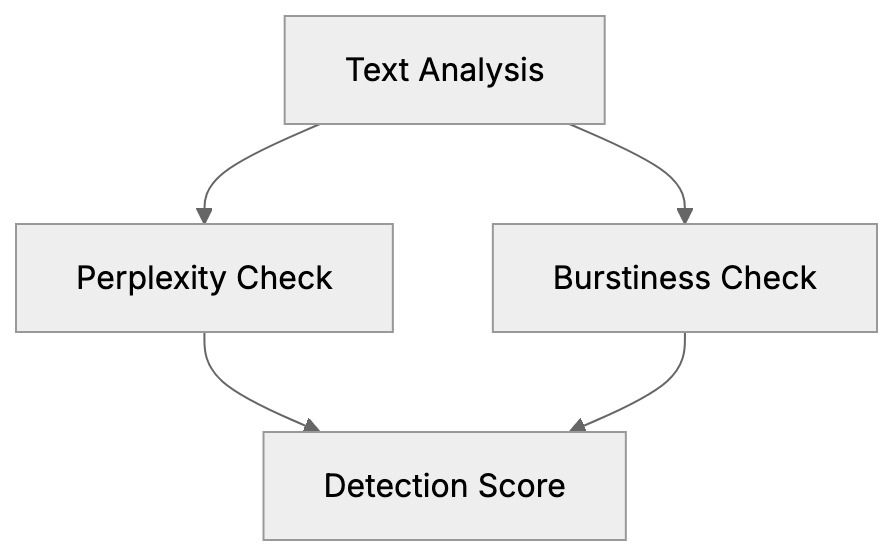
AI writers generate text based on patterns, creating detectable footprints. Two main concepts are key: perplexity measures text predictability; AI typically produces text with low perplexity due to likely word choices. Burstiness examines sentence length variation; humans often write with varied sentence structures, while AI tends towards uniformity. AI detection tools use these markers.
AI models favor specific patterns, using formal language and a predictable structure—introduction, multiple points, and conclusion. This formulaic style is polished but lacks human thought processes’ natural messiness.
AI Writing Detection Core Concepts:
Common Words That Signal AI Writing
Certain words appear disproportionately in ChatGPT text, serving as red flags:
- Look: Rare in human writing but common in AI.
- Use: AI overuses.
- Complete: AI emphasizes completeness.
- Also: Overused transitions.
- Mix: AI metaphor overuse.
- Improve and simplify: AI defaults, where humans prefer “enhance” and “streamline.”
- Careful and essential: AI favors complex adjectives.
Multiple such words in an article suggest AI authorship.
Top AI Content Detectors
Several AI detection tools analyze text using machine learning models:
| Tool | Website | Key Features |
|---|---|---|
| GPTZero | gptzero.me | Analyzes perplexity and burstiness |
| Copyleaks | copyleaks.com | Enterprise-grade, widely used by universities |
| Originality.ai | originality.ai | Popular with content marketers, checks plagiarism |
| QuillBot AI Detector | quillbot.com/ai-content-detector | Free option with decent accuracy |
| Turnitin | turnitin.com | Academic standard with integrated AI detection |
| ZeroGPT | zerogpt.com | Free, user-friendly interface |
| Writer.com AI Detector | writer.com/ai-content-detector | Free with quick results |
AI Content Detection Process:

| Sapling AI Detector | sapling.ai/ai-content-detector | Developer-friendly API available |
GPTZero leads as a dedicated AI detector, offering granular analysis.
How AI Detection Tools Work
AI content detectors use machine learning models trained to differentiate between human and AI writing. They assess factors like:
- Perplexity Measurement: Low perplexity suggests AI.
- Burstiness Analysis: Uniformity hints at AI.
- Word Frequency Analysis: Monitors AI-specific words.
- Syntactic Pattern Recognition: Finds preferred AI structures.
Most tools provide a likelihood percentage based on patterns.
Limitations of AI Detection
No method is foolproof due to factors impacting accuracy:
- Continuous AI Improvements: Newer AI tools generate more human-like text.
- Human Editing: Can disguise AI origins.
- Formal Writing Style: Might appear AI-generated.
- Short Text Challenges: Longer pieces provide better data.
- Language Support: Best performance in English.
Why AI Writing Detection Matters for Your Business
content quality impacts business success. AI-generated text can lack oversight, affecting accuracy and engagement. SEO performance suffers with shallow content. Google may penalize non-compliant AI content.
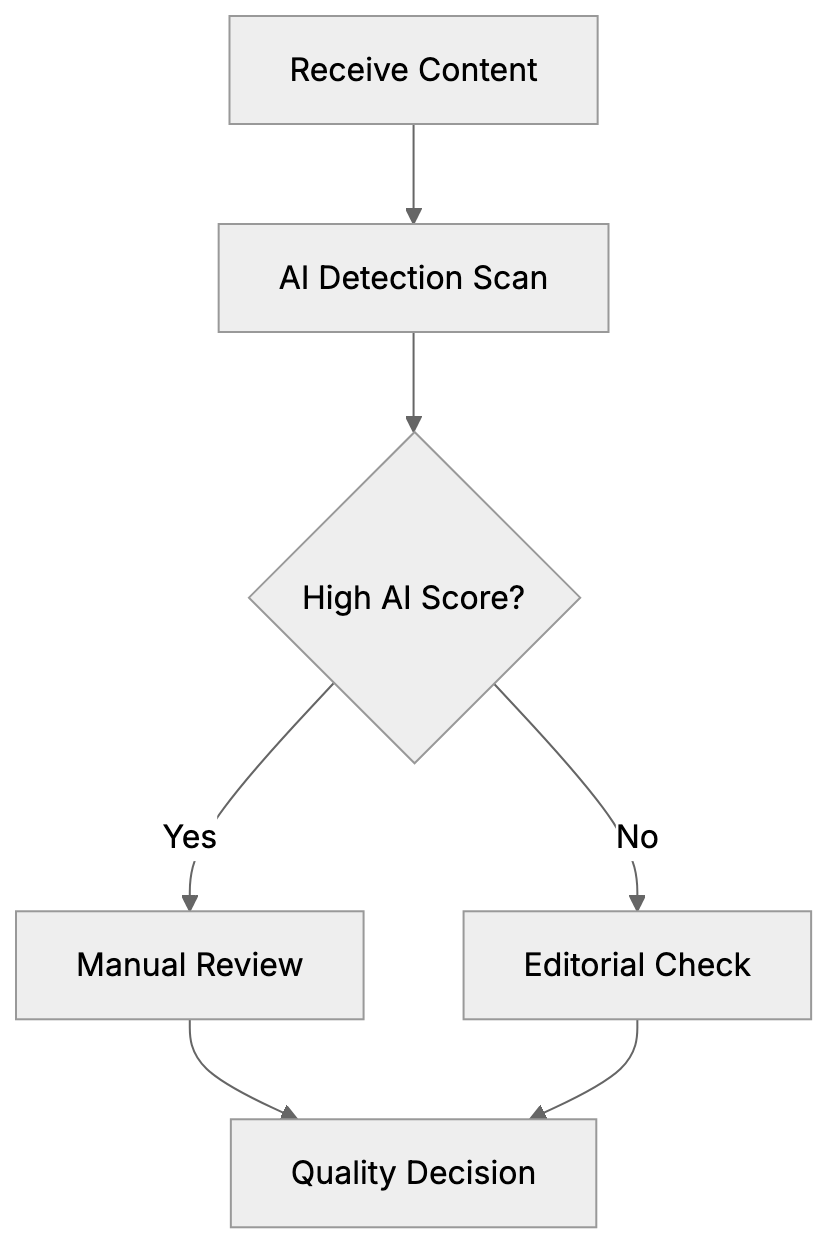
Content Quality Assurance Workflow:
 AI content risks uniformity, lacking brand voice. AI content detectors maintain unique tones. Tools assure agencies’ human-crafted content claims.
In academia, detecting AI in submissions upholds integrity. Legal sectors cannot risk AI errors, making detection crucial for expert-authored documents.
Using AI Detection Results
Receiving an AI detection score is only the beginning:
- Review High-Scoring Sections: Check for accuracy.
- Don’t Rely Solely on Scores: False positives occur.
- Combine Detection with Quality Control: Use alongside editorial checks.
- Screen Potential Writers: Identify AI misuse.
- Educate Teams: Train on AI patterns.
Practical Tips for Manual AI Detection
Trained eyes can spot AI content:
- Note Repetitive Phrasing: AI restates in varying words.
- Look for Depth: AI lacks deep analysis.
- Check Examples: AI often omits real-world cases.
- Examine Structures: AI intros and conclusions are formulaic.
The Future of AI Writing Detection
Detection technology will evolve with AI writing improvements.
Potential Solutions include watermarking AI text and blockchain for human work. Detection models will need updates. Regulatory impacts may mandate AI content disclosure, but quality standards remain pivotal.
Conclusion
Detecting AI-generated text involves recognizing patterns and using specialized tools. Words like look, leverage, and essential frequently appear in AI writing. Tools like GPTZero analyze texts for AI likelihood. No method is foolproof; combining automated detection with manual evaluation strengthens content quality assurance. Focus on valuable, accurate, and audience-serving content amidst evolving AI technology.
Frequently Asked Questions
How can I identify AI-generated content in my writing?
Look for patterns such as low perplexity and uniform sentence structures, which are common in AI writing. Additionally, be aware of overused words like 'look', 'use', and 'complete' that indicate AI authorship.
What are the limitations of AI detection tools?
No detection tool is foolproof; factors such as the continuous evolution of AI, human editing, and the length of the text can affect accuracy. Tools may perform best in English and may struggle with short texts.
How do AI detection tools determine if content is AI-generated?
These tools analyze several factors, including perplexity, burstiness, and preferred word usage. They use machine learning models to assess the likelihood of AI authorship based on these patterns.
What steps should I take if my content is flagged as AI-generated?
Review the flagged sections for accuracy and depth. Don’t solely rely on detection scores; combine them with editorial checks and ensure that the writing meets quality standards.
Are AI detection tools suitable for all types of content?
While they are helpful for various businesses, content quality assurance in creative writing, journalism, and academia is critical. Each sector may have different requirements for accuracy and tone.
Can I improve my writing to avoid being flagged by AI detectors?
Yes, vary your sentence structure and use unique phrasing. Focus on providing in-depth analysis and real-world examples instead of relying on formulaic writing patterns.
What is the future of AI writing detection?
The future will likely see advancements in detection technology alongside improvements in AI writing. Innovations such as watermarking or blockchain may emerge, enhancing transparency in authorship.